mandag 11. april 2011

søndag 10. april 2011

lørdag 9. april 2011

fredag 8. april 2011

torsdag 7. april 2011

I'm seeing things
I'm hearing things

Where do I start?
Where do I stop?

Where do I start?
Where do I stop?

Where do I start?
Where do I stop?

Where do I start?
Where do I stop?

Where do I start?
Where do I stop?

I'm hearing things
I'm seeing things
'There may be some people who kill themselves,' wrote Al Alvarez in The Savage God, his classic 1971 study of suicide, 'in order to achieve a calm and control they never find in life.' He went on to claim that for poet Sylvia Plath, a personal friend who'd committed suicide in 1963, it was a desperate way out of a corner she had boxed herself into. 

Sarah Kane by Aleks Sierz
'Actually, I see her more as a classical writer. Her work is connected with a form of theatre that is quite confrontational because it doesn't reassure you with social context or Freudian psychology - it doesn't explain things. It just presents you with these austere, extreme situations. She is the only contemporary writer who has that classical sensibility.'
(...)
But 4.48 Psychosis inevitably raises troubling questions about the literature of despair. On the one hand, sceptics see Kane's work as a literal reflection of her life. The Telegraph's critic, Charles Spencer, wrote in May 1998 that 'you feel her work owes much more to clinical depression than to real artistic vision'. You could argue that her writing simply reproduces the fears and confusions of mental illness.

On the other hand, Kane's defenders - such as Graham Whybrow, the Royal Court's literary manager - emphasise her dramatic technique. Not only did she have a first-class honours degree in drama, but her work never stayed still. 'Each new play,' he says, 'was a new departure and to some extent an investigation of form. She left behind a body of work which is consistent in vision and diverse across a range of subjects.'

(...)
Besides, what she admired most about Beckett was his sense of overcoming the darkness. When I talked to her, she emphasised that she was essentially interested in love and affection. 'I don't find my plays depressing or lacking in hope,' she said. 'To create something beautiful about despair, or out of a feeling of despair, is for me the most hopeful, life-affirming thing a person can do.'
(...)
If, as Alvarez suggests, some people kill themselves to gain control and find calm, the irony is that Kane, who all her life struggled against being pigeonholed as a 'woman writer', is now powerless against being labelled a suicidal artist. And the problem with seeing Kane as an example of the Sylvia Plath syndrome - with her work refracted through the optic of her death - is that it reduces her art to biography, and limits its meaning.
(...)"There is a poem by Robert Frost that goes: The woods are lovely, dark and deep./ But I have promises to keep,/ And miles to go before I sleep."

onsdag 6. april 2011

Fragments of power. No power.
Fragments of will. No will.
Fragments of thoughts, consider revising.

Consider choosing. Or not choosing.

One button, too many holes.
Only two choices.

Though nothing may remain but the rumour.
Though nothing may remain but the memory of an odour.

Wire from emotion to vision. Cut.
I can still feel the pain in my index finger.

The atoms and the molecules of my hand blends with the atoms and the molecules of the…

…who pushed the mute button?
I did. I am.

A line appears;
parting is all I know of hell.

And without him, I will continue,
stuck inside this flesh.

Attempting to see me, through his eyes.
But all I can find is a reflection of another person,
Aroused, by her own naked skin.

Everything is the same, can't you see?
Even though the sensation may be new.
You’re still by yourself.

I, whom I’ve never met.

And still.
Veracity bores me:

I thought I was silent.
Till I went silent.

I thought I was unique.
Till he left.

And now this question of accepting.
I never wanted it.

The Choice Between Art and Life (LA BELLE NOISEUSE)

http://www.jonathanrosenbaum.com/?p=7260

Passion Jean-Luc Godard

Louise Dahl-Wolfe, Ruth Bernhard,

Night Bathing, 1939
The Seed, 1971

tirsdag 5. april 2011

Confessional poetry

Confessional poetry emphasizes the intimate, and sometimes unflattering, information about details of the poet's personal life, such as in poems about mental illness, sexuality, and despondence. The confessionalist label was applied to a number of poets of the 1950s and 1960s.


One of the most well-known poems by a confessional poet is "Daddy" by Sylvia Plath. Addressed to her father, the poem contains references to the Holocaust but uses a sing-song rhythm that echoes the nursery rhymes of childhood:
Daddy, I have had to kill you.
You died before I had time--
Marble-heavy, a bag full of God,
Ghastly statue with one gray toe
Big as a Frisco seal
“Daddy, daddy, you bastard, I’m through.”

He Wishes For The Cloths Of Heaven by William Butler Yeats

Had I the heavens' embroidered cloths,
Enwrought with golden and silver light,
The blue and the dim and the dark cloths
Of night and light and the half-light,
I would spread the cloths under your feet:
But I, being poor, have only my dreams;
I have spread my dreams under your feet;
Tread softly because you tread on my dreams.

Umulig å være i dårlig humør

når været er så fint i OderBruch!

Vorschau Neulewin Oderbruch


og neste helg§

mandag 4. april 2011

Markus Schinwald at the Austrian Pavilion

Austria will be represented this year at the Biennale di Venezia by artist Markus Schinwald, born 1973 in Salzburg and now living and working in Vienna and Los Angeles. The says Biennale commissioner will be artist Eva Schlegel. Schinwald's works go beyond visual perception and condense that moment when the rational mind's control of the body diminishes. This is to be seen particularly clearly in the manipulations of portraits, lithographs and sketches from the 19th century purchased at auctions, in antique shops or flea markets: the artist matches his interventions to the style of the original so closely that they look as if they had always been there. In his Venice project, Markus Schinwald examines the Austrian Pavilion built 1934 by Josef Hoffmann, an architectural landmark in and around the Giardini district. In the context of the general theme of ILLUMInations as defined by Bice Curiger, Markus Schinwald negotiates the representation and manipulation of space, time, light and shadow. Not only does he transform the spatial experience through an element of disturbance between the visible and the concealed, but also leaves, and addresses, the pavilion's architecture and history as it is, with all its breaches, rifts, and blanks, and thus succeeds to give sociopolitical visibility to the inscrutable.

Reality killed the cat, but curiosity brought it back.
((Reality killed the act))

søndag 3. april 2011

Siste del av: To Have Done with the Judgement of God, Antonin Artaud

      NO
then
to negation;

and this point
comes when they press me,

when they pressure me
and when they handle me
until the exit
from me
of nourishment,
of my nourishment
and its milk,

and what remains?

That I am suffocated;

and I do not know if it is an action
but in pressing me with questions this way
until the absence
and nothingness
of the question
they pressed me
until the idea of body
and the idea of being a body
was suffocated
in me,

and it was then that I felt the obscene

and that I farted
from folly
and from excess
and from revolt
at my suffocation.

Because they were pressing me
to my body
and to the very body


and it was then
that I exploded everything
because my body
can never be touched.


-------
http://ndirty.cute.fi/~karttu/tekstit/artaud.htm
Christian Bök
Ten Maps of Sardonic Wit


atoms in space now drift
on a swift and epic storm

soft wind can stir a poem

snow fits an optic dream
into a scant prism of dew

words spin a faint comet

some words in fact paint
two stars of an epic mind

manic words spit on fate
Robert Barry
Art Work (1970)

It is always changing. It has order. It doesn't have a specific place. Its boundaries are not fixed. It affects other things. It may be accessible but go unnoticed. Part of it may also be part of something else. Some of it is familiar. Some of it is strange. Knowing of it changes it.

Kane- 4.48 Psychosis

Plath

lørdag 2. april 2011

Malena - e - Mio Vestito Nero

 Den siste barndomsdrømmen. Ganske passe film, men fin sang.

Ma lamore, no.
Lamore mio non può
disperdersi nel vento, con le rose.
Tanto è forte che non cederà
non sfiorirà.
io lo veglierò
io lo difenderò
da tutte quelle insidie velenose
che vorrebbero strapparlo al cuor,
povero amor!

fredag 1. april 2011

odilon redon

torsdag 31. mars 2011

Christina Hendricks

Mad Men, Paul Kinsey:
I had the idea. Then I lost it. There was nothing, and then there was it, and now it's nothing again.

Kandinsky, Blue

Phantom arm, synthesis, mirror neurons and so on

too much TED,  losing grip on reality

Ieri, Oggi, Domani (parte 1) - film completo in Italiano

Italia,

Kanskje hit?

onsdag 30. mars 2011

The Shaking Woman

quote S.H:
something is going on unconsciously in me

dropping knowledge QUESTION: Siri Hustvedt, New York

ser·en·dip·i·ty

ser·en·dip·i·ty

[ser-uhn-dip-i-tee]
–noun
1.
an aptitude for making desirable discoveries by accident.
2.
good fortune; luck: the serendipity of getting from unknown sources.
Hobbes writes the following “Of Man’’:
When in the mind of man, Appetites, and Aversions, Hopes, and Feares, concerning one and the same thing, arise alternately; and divers goods and evil consequences of the doing, or omitting the thing propounded, come successively into our thoughts; so that sometimes we have an Appetite to it; sometimes an Aversion from it; sometimes Hope to be able to do it; sometimes Despaire, or Feare to attempt it; the whole summe of Desires, Aversions, Hopes and Fears, continued till the thing will be either done, or thought impossible, is that we call deliberation (...).

Here is the key passage from book 3 of Seneca’s On Anger, in the section on moral therapy called “ How to Avoid the Onset of Anger’’:
We may find help in that sound advice of Democritus which points to tranquility “if we refrain from doing many things, either in private or in public, or anything beyond our powers.’’ If one runs off on many different activities, one will never have the luck to spend a day without some annoyance arising, from someone or something, to dispose the mind to anger. If one hurries through the crowded parts of the city, one cannot help knocking into many people; one is bound to slip, to be held back, to be splashed. In the same way, if one’s course of life is fragmented and always taking a different direction, many things will get in the way and there will be much to complain about—one man has disappointed us, another put us off, a third cut us short; our plans did not take the course that we intended. No one has fortune so much on his side as always to answer to his wishes, if he attempts many things. As a result, should he do so, he finds his plans thwarted and becomes impatient with people and things. At the slightest provocation he loses his temper with the person involved, with the matter in hand, with his position, with his luck, with himself. So if the mind is to have the possibility of being calm, it must not be tossed about nor, as I said, exhausted by doing many things or anything too ambitious for its powers. (...)


We can learn a good deal about the rhetoric of human nature in early modern Europe simply by asking what passions were.
When we do, we find not only that their descriptions disagree but also that the things described as passions seem incommensurable. Are passions tangible “things’’ residing in the soul, or are they dispositions of the heart, or beliefs of the mind? Is passion a matter of personal expression, or is it something essentially social that a person performs? Do they come from our interior, or from the things we perceive? Can they be measured and manipulated— their causes controlled—or do passions elude control by their very nature? Are they divine, diabolical, or human, and can we distinguish them according to their origin? Are they the enabling condition of virtue or its enemy? Are they necessary or disposable? What is their number and what do they do?

I guess with everything in life there's a place of balance

Absalon

Kurt Masur & Jessye Norman & Gewandhausorchester Leipzig – Strauss, R.: Vier Letzte Lieder

Strauss, R.: Four Last Songs, etc.
(Spotify)

tirsdag 29. mars 2011

mandag 28. mars 2011

The Other: "Rest Energy", 1980

The Ballad of Sexual Dependency Nan Goldin’s slideshow at MoMA

Ryan in the tub, Provincetown, Mass. 1976
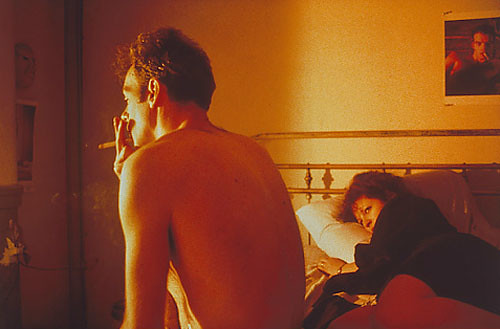
Nan and Brian in bed, New York City 1983

 Nan Goldin’s The Ballad of Sexual Dependency is one of the most enduring works in recent photographic history. What began in 1979 as slideshows for her friends turned into hundreds and hundreds of photos, a visual diary that is still being written today, 30 years later, as well as a book, first published by Aperture in 1986 and still being printed. The version of the slideshow acquired by the Museum of Modern Art in 2004 contains 690 slides and is 43 minutes long. Though ongoing and including photographs taken all over the world, the heart of the Ballad lies in 1980s New York, a time and place where Goldin and her core group of friends were young and looked for all the world as though they owned it.

The past is the present: traumatizing experiences keeps repeating themself as present situations

The Method of Loci
Cicero told a traditional story about how the method of loci was discovered. A Greek poet named Simonides was entertaining a group of wealthy noblemen at a banquet. Suddenly a pair of mysterious figures called him outside. They turned out to be messengers from the Olympian gods Castor and Pollux, praised by Simonides in his poem. As soon as Simonides stepped outside, the roof of the banquet hall collapsed, squashing everybody inside. The mangled corpses could not be identified until Simonides stepped forward, pointed to the place where each victim had been sitting, and said each name in turn.

How did Simonides accomplish this feat? He mentally recreated the scene of the banquet, visualizing each reveler in his place. When he saw the places, it helped him remember the person who had been sitting there.


Cotard delusion
The Cotard delusion or Cotard's syndrome or Walking Corpse Syndrome[1] is a rare neuropsychiatric disorder in which people hold a delusional belief that they are dead (either figuratively or literally), do not exist, are putrefying, or have lost their blood or internal organs. In rare instances, it can include delusions of immortality[2] (mutually excluding the possibility of such a condition of death as an oblivion, unless regarded as just oneself to another or others).

---> The pleasure of uncertainty. Everything is the same, can't you see it?

David Shrigley

DOGVILLE DIALOGLISTE  
Final scene

GRACE
So what is it? What is it, the thing…the thing that you don't like about me?

THE BIG MAN
It was a word you used that provoked me. You called me arrogant.

GRACE
To plunder, as it were, a God given right. I'd call that arrogant, daddy.

THE BIG MAN
But that is exactly what I don't like about you. It is you that is arrogant!

GRACE
That's what you came here say? I'm not the one passing judgement, Daddy. You are.

THE BIG MAN
You do not pass judgement, because you sympathize with them. A deprived childhood and a homicide really isn't necessarily a homicide, right? The only thing you can blame is circumstances. Rapists and murderers may be the victims, according to you. But I, I call them dogs, and if they're lapping up their own vomit the only way to stop them is with the lash.

GRACE
But dogs only obey their own nature. So why shouldn't we forgive them?

THE BIG MAN
Dogs can be taught many useful things, but not if we forgive them every time they obey their own nature.

GRACE
So I'm arrogant. I'm arrogant because I forgive people?

THE BIG MAN
My God. Can't you see how condescending you are when you say that? You have this preconceived notion that nobody, listen, that nobody can't possibly attain the same high ethical standards as you, so you exonerate them. I can not think of anything more arrogant than that. You, my child…my dear child you forgive others with excuses that you would never in the world permit for yourself.

GRACE
Why shouldn't I be merciful? Why?

THE BIG MAN
No no no. You should be merciful, when there is time to be merciful. But you must maintain your own standard. You owe them that. You owe them that. The penalty you deserve for your transgressions, they deserve for their transgressions.

GRACE
They are human beings.

THE BIG MAN
No no no. Does every human being need to be accountable for their action. Of course they do. But you don't even give them that chance. And that is extremely arrogant. I love you. I love you. I love you to death. But you are the most arrogant person I've ever met. And you call me arrogant! I have no more to say.

GRACE
You are arrogant. I'm arrogant. You've said it. Now you can leave.

THE BIG MAN
And without my daughter I suppose?

GRACE
Uhm…

THE BIG MAN
I said without my daughter?

GRACE
Hmm, yes!

THE BIG MAN
Well.

GRACE
Yes.

THE BIG MAN
Well, you decide, you decide. Grace, they say you are having some trouble here.

GRACE
No. No more trouble than back home.

THE BIG MAN
I'll give you a little time to think about this. Perhaps you will change your mind.

GRACE
I won't.

THE BIG MAN
Listen, my love…power is not so bad…I am sure that you can find a way to make use of it in your own fashion… Take a walk and think about it.

GRACE
The people who live here are doing their best under very hard circumstances.

THE BIG MAN
If you say so, Grace. But is their best really good enough? Do they love you?

NARRATOR
Grace had already thought for a long time. She had known that if she were not shot when the gangsters arrived she would be faced with her father's suggestion that she return, to become a conspirator with him and his gang of thugs and felons and she did not need any walk to reconsider her response to that, even though the difference between the people she knew back home and the people she'd met in Dogville had proven somewhat slighter than she'd expected.

Grace looked at the gooseberry bushes so fragile in the smooth darkness.

It was good to know that if you did not treat them ill, they would be there come spring as always, and come summer they'd again be bursting with the quite incomprehensible quantity of berries that were so good in pies, specially with cinnamon.

NARRATOR(cont'd)
Grace looked around at the frightened faces behind the windowpanes that were following her every step, and felt ashamed of being part of inflicting that fear. How could she ever hate them for what was at bottom merely their weakness? She would probably have done things like those that had befallen her if she'd lived in one of these houses, to measure them by her own yardstick as her father put it. Would she not, in all honesty, have done the same as Chuck and Vera and Ben and Mrs. Henson and Tom and all these people in their houses?

NARRATOR(cont'd)
Grace paused. And while she did, the clouds scattered and let the moonlight through and Dogville underwent another of those little changes of light. It was if the light, previously so merciful and faint, finally refused to cover up for the town any longer. Suddenly you could no longer imagine a berry that would appear one day on a gooseberry bush, but only see the thorn that was there right now. The light now penetrated every unevenness and flaw in the buildings… and in… the people! And all of a sudden she knew the answer to her question all to well:

If she had acted like them, she could not have defended a single one of her actions and could not have condemned them harshly enough. It was as if her sorrow and pain finally assumed their rightful place.

No, what they had done was not good enough.

And if one had the power to put it to rights, it was one's duty to do so, for the sake of the other towns. For the sake of humanity, and not least, for the sake of the human being that was Grace herself.
søndag 27. mars 2011

Eugène DELACROIX, Jeune orpheline au cimetière, vers 1824

Louvre,

Hamlet - David Tennant, Patrick Stewart, Penny Downie. Act 1, Scene 1.

Francisco Zurbarán


MQ.
 A moment of clarity
The silence depressed me. It wasn’t the silence of silence. It was my own silence.
— Sylvia Plath, The Bell Jar

fin

Salvador Dali - Lanvin Chocolate

La solitude -Barbara- (avec sous-titres)

Brenda Lee - Break It to Me Gently (Single)

søndag 13. mars 2011

søndag 6. mars 2011

mandag 28. februar 2011

fredag 25. februar 2011

THE LITTLE MUTE BOY

The little boy was looking for his voice
In a drop of water

I do not want it for speaking with;
I will make a ring of it

so that she may wear my silence
(omskrevet Lorca)
DESIRE OF A STATUE


Rumor:
Though nothing may remain but the rumor.


Odor:
Though nothing may remain but the odor.


But tear out of me the memory
and the color of the old hours.
(-)
f.g.lorca

onsdag 23. februar 2011

fredag 18. februar 2011

søndag 13. februar 2011

fredag 11. februar 2011

M*SCHINWALD;

from soft to soft
a love divided

given nothing but to wonder

buckled broken
words speak bolder
the air is cold
but the earth is colder

gestures mask intention
marching
waiting
bending
driving
the voluptuous suck
of hollow time

alternate two by two
and one by four

the borders run from south to north
north to south
south to north

two are watching
the geography of crime

little rooms
little space between breaths
little marvels
in a lifelong occupation
of sorting
filing
moving
pushing

a charm of Litanies
a laboured parody
a chain of flaws

a flow of habits dance
a well intentioned chance
a postured pause

its warm inside
waking
looking
taking

gestures mask intention
lost divided surveyed charmer

shelves are warm
but the fold is warmer

bring a wish within your clothes
a language of impidents
bring a shackle of lassitude
a labour with no reason

limbs extend
fingers unfold
the mad pushing of green green green

from soft to soft
widowed hands touch softer

False Silence, Bruce N

http://ubu.artmob.ca/sound/nauman_bruce/Bruce-Nauman_09-False-Silence.mp3

søndag 30. januar 2011

torsdag 27. januar 2011

...---.....cmyk

Blake slots a manically speed-up sample from Kelis’s ‘Caught Out There’ into the negative space of Aaliyah’s ‘Are You That Somebody?’, creating a sonic whirlwind of opposition. While Kelis cusses her boy for betraying her (‘Look I found her red coat/Look I found her’), Aaliyah and Timbaland engage in a breathy back-and-forth, setting the stage for seduction.
And now I'm tired. Tired of having foolish habits and tired of having hands. But most of all I am tired of struggling against the feeling of guilt after repeating all this bullshit, day after day.

Elektronika; spillelisten som bare vokser

blandings.+
Nei, jeg har ikke sett noe fantastisk etter at jeg kom tilbake,
men denne fant jeg nettopp (lenge etter alle andre):