

onsdag 9. november 2011

lørdag 5. november 2011
fredag 4. november 2011

tirsdag 25. oktober 2011

mandag 24. oktober 2011
søndag 23. oktober 2011
Lil Kim***Put it in my mouth
My baby left me
Left me sad and blue
I didn't know what to do
Without my baby, baby, baby,
And then I met his best friend
... And then he took me to his house
And I said...I said...I said...
(What you said baby)
Let me tell you what I said
Put it in my mouth
torsdag 20. oktober 2011
lørdag 15. oktober 2011

fredag 14. oktober 2011
torsdag 29. september 2011

tirsdag 13. september 2011


LOCATION
Ser ganske nitrist akkurat ut nå (tirsdag 13. september 2011 12:30:00,
men det er herfra vi skal filme. (bildet oppdateres).

men det er herfra vi skal filme. (bildet oppdateres).

mandag 12. september 2011
lørdag 10. september 2011
torsdag 25. august 2011


fredag 19. august 2011
torsdag 18. august 2011
fredag 5. august 2011
I can’t believe it’s not bread-brød
8 egg
1 boks kesam
2 ss bakepulver
8 ss linfrø
170 gram kruskakli
100 gram sesamfrø
90 gram solsikkefrø
100 gram pistasjnøtter
100 gram valnøtter
6 ss rapsolje
1 liten klype maldonsalt
Pisk eggene lett og bland i kesam og olje. Grovhakk nøttene og bland de tørre ingrediensene. Tilsett det tørre og bland sammen til deigen har en litt “kladdete” konsistens. Ha bakepapir i brødformene og stek på 180 grader i 55 minutter.


onsdag 27. juli 2011
tirsdag 26. juli 2011
Bun Bo (Grilled Lemongrass Beef Noodle Salad)
About This Recipe
"From a Vietnamese recipe website, this is delicious, very healthy and perfect for those warm summer days.
Ingredients
o 225 g rice vermicelli
o 450 g beef, flank steaks or round beef, cut into strips
o 1 onions, peeled and finely chopped
o 3 garlic cloves, peeled
o 2 stalks lemongrass, finely chopped
o 1 teaspoon salt
o 1/2 teaspoon fresh ground black pepper
o 1/2 teaspoon curry powder (optional)
o 1 tablespoon fish sauce
o 200 g lettuce, shredded
o 1 cucumbers, peeled and shredded
o 225 g bean sprouts
o 40 g fresh mint leaves
o 40 g coriander, coarsely chopped ( cilantro)
o 150 g carrots, shredded
o 100 g crushed roasted peanuts
Directions
1. To make the marinade paste, pound the onion, garlic and lemongrass with a mortar and pestle or with a food processor until coarse. Add in the salt, black pepper, curry powder if desired, and fish sauce. Stir mixture over the beef and marinate for 1 hour or overnight if possible.
2. Bring a saucepan of water to the boil, add the vermicelli noodles and cook for 3-5 minutes or until tender. Drain, refresh under cold water, drain again and set aside.
3. Thread the meat strips onto the bamboo skewers. Grill till done to taste.
4. To serve, place a portion of noodles in a large soup bowl. Then place the beef, lettuce, cucumber, bean sprouts, mint leaves, fresh coriander, carrot and 1 teaspoon crushed peanuts on top of the noodles. Dress the ingredients with 2 tablespoons nuoc cham, or more to taste - I use around 4 tablespoons for each serving. Toss the ingredients together and serve. Repeat the process for each serving.
torsdag 21. juli 2011
lørdag 2. juli 2011


fredag 1. juli 2011
torsdag 16. juni 2011
tirsdag 14. juni 2011
Here and Now
by Stephen Dunn
for Barbara
There are words
I've had to save myself from,
like My Lord and Blessed Mother,
words I said and never meant,
though I admit a part of me misses
the ornamental stateliness
of High Mass, that smell
of incense. Heaven did exist,
I discovered, but was reciprocal
and momentary, like lust
felt at exactly the same time—
two mortals, say, on a resilient bed,
making a small case for themselves.
You and I became the words
I'd say before I'd lay me down to sleep,
and again when I'd wake—wishful
words, no belief in them yet.
It seemed you'd been put on earth
to distract me
from what was doctrinal and dry.
Electricity may start things,
but if they're to last
I've come to understand
a steady, low-voltage hum
of affection
must be arrived at. How else to offset
the occasional slide
into neglect and ill temper?
I learned, in time, to let heaven
go its mythy way, to never again
be a supplicant
of any single idea. For you and me
it's here and now from here on in.
Nothing can save us, nor do we wish
to be saved.
Let night come
with its austere grandeur,
ancient superstitions and fears.
It can do us no harm.
We'll put some music on,
open the curtains, let things darken
as they will.
mandag 13. juni 2011

søndag 12. juni 2011
Miracles
by Walt Whitman
Why, who makes much of a miracle?
As to me I know of nothing else but miracles,
Whether I walk the streets of Manhattan,
Or dart my sight over the roofs of houses toward the sky,
Or wade with naked feet along the beach just in the edge of
the water,
Or stand under trees in the woods,
Or talk by day with any one I love, or sleep in the bed at night
with any one I love,
Or sit at table at dinner with the rest,
Or look at strangers opposite me riding in the car,
Or watch honey-bees busy around the hive of a summer
forenoon,
Or animals feeding in the fields,
Or birds, or the wonderfulness of insects in the air,
Or the wonderfulness of the sundown, or of stars shining so
quiet and bright,
Or the exquisite delicate thin curve of the new moon in spring;
These with the rest, one and all, are to me miracles,
The whole referring, yet each distinct and in its place.
To me every hour of the light and dark is a miracle,
Every cubic inch of space is a miracle,
Every square yard of the surface of the earth is spread with
the same,
Every foot of the interior swarms with the same.
To me the sea is a continual miracle,
The fishes that swim—the rocks—the motion of the waves—
the ships with men in them,
What stranger miracles are there?
tirsdag 7. juni 2011
mandag 16. mai 2011
I don't want to use my name!
(...)
Woman in front of a poster of herself.
You still don't have a face.
She may kill me,
it depends on whether she's hungry.
Inside these images
there's nothing but a pumping
bloodsoaked...
Clearly, everything I said
and did,
was a long shot.
We didn't hear a word.
What have you ever heard.
Woman in front of a poster of herself.
You still don't have a face.
She may kill me,
it depends on whether she's hungry.
Inside these images
there's nothing but a pumping
bloodsoaked...
Clearly, everything I said
and did,
was a long shot.
We didn't hear a word.
What have you ever heard.

onsdag 11. mai 2011
mandag 9. mai 2011


søndag 8. mai 2011
lørdag 7. mai 2011
torsdag 5. mai 2011

tirsdag 3. mai 2011
When I was in the brig
Every single woman there
Was in that brig because of a man
Different reasons, yes
But it was because of a man
And when you join the military
No matter what anybody says
It’s a mans world
You’ve got to either equal men or
Be controlled by men
If you want to be their equal
You’ve got to be strong
Their gonna try to control you
You need to just step up and tell them
You know; show them
Who’s the boss
I’m not gonna take that
I’m not gonna let you power me
You know, control me
Because I’m a woman and you’re a man
It’s not gonna happen
Even though it’s the military, I mean hell
If you’re in the military; you’ve got a gun
Use it
If I would have thought about that back then, by God I would have
But, I was blinded by being in love, with a man
mandag 2. mai 2011


søndag 1. mai 2011
fredag 29. april 2011
onsdag 27. april 2011


mandag 25. april 2011
Anne Sexton - A Curse Against Elegies
Oh, love, why do we argue like this?
I am tired of all your pious talk.
Also, I am tired of all the dead.
They refuse to listen,
so leave them alone.
Take your foot out of the graveyard,
they are busy being dead.
Everyone was always to blame:
the last empty fifth of booze,
the rusty nails and chicken feathers
that stuck in the mud on the back doorstep,
the worms that lived under the cat's ear
and the thin-lipped preacher
who refused to call
except once on a flea-ridden day
when he came scuffing in through the yard
looking for a scapegoat.
I hid in the kitchen under the ragbag.
I refuse to remember the dead.
And the dead are bored with the whole thing.
But you -- you go ahead,
go on, go on back down
into the graveyard,
lie down where you think their faces are;
talk back to your old bad dreams.
------
I measure every Grief I meet
I measure every Grief I meet
With narrow, probing, Eyes --
I wonder if It weighs like Mine --
Or has an Easier size.
I wonder if They bore it long --
Or did it just begin --
I could not tell the Date of Mine --
It feels so old a pain --
I wonder if it hurts to live --
And if They have to try --
And whether -- could They choose between --
It would not be -- to die --
I note that Some -- gone patient long --
At length, renew their smile --
An imitation of a Light
That has so little Oil --
I wonder if when Years have piled --
Some Thousands -- on the Harm --
That hurt them early -- such a lapse
Could give them any Balm --
Or would they go on aching still
Through Centuries of Nerve --
Enlightened to a larger Pain -
In Contrast with the Love --
The Grieved -- are many -- I am told --
There is the various Cause --
Death -- is but one -- and comes but once --
And only nails the eyes --
There's Grief of Want -- and Grief of Cold --
A sort they call "Despair" --
There's Banishment from native Eyes --
In sight of Native Air --
And though I may not guess the kind --
Correctly -- yet to me
A piercing Comfort it affords
In passing Calvary --
To note the fashions -- of the Cross --
And how they're mostly worn --
Still fascinated to presume
That Some -- are like My Own --
---------
THE MYSTERY OF PAIN.
Pain has an element of blank;
It cannot recollect
When it began, or if there were
A day when it was not.
It has no future but itself,
Its infinite realms contain
Its past, enlightened to perceive
New periods of pain.
-----------
Heart! We will forget him!
You and I -- tonight!
You may forget the warmth he gave --
I will forget the light!
When you have done, pray tell me
That I may straight begin!
Haste! lest while you're lagging
I remember him!
Sara Teasdale
After Love
There is no magic any more,
We meet as other people do,
You work no miracle for me
Nor I for you.
You were the wind and I the sea—
There is no splendor any more,
I have grown listless as the pool
Beside the shore.
But though the pool is safe from storm
And from the tide has found surcease,
It grows more bitter than the sea,
For all its peace.

søndag 24. april 2011
fredag 22. april 2011
Sometimes in the shower
Sometimes in the closet
Often in the kitchen
Anyhow or anywhere
The sweetest taste
Of melancholy and self-pity
Drunk tired
Retarded youth
Slowly aging
Waiting for the evening to pass
Take that last sip
And gaze into the bottle
Your reflection fades into a well-known soap opera
Anything can happen
From now and minutes ahead
Whilst the night welds round me
And sleep swabs every taste of romance out of it
----
PAIN (KILLER)
Nagging echoes
Of yesterday's poison
Slams my guts
To pieces
EXE raske utdrag
EXHAUSTION
& EXUBERANCE
Ways to Defy the Pressure to Perform
by Jan Verwoert
(...)
an existential exuberance, i.e., a way to perform without any mandate or legitimation, in response to the desires and dreams of other people, but without the aim or pretense of merely fulfilling an existing demand. It is a way of always giving too much of what is not presently requested. It is a way of giving what you do not have to others who may not want it. It is a way of transcending your capacities by embracing your incapacities and therefore a way to interrupt the brute assertiveness of the I Can through the performance of an I Can’t performed in the key of the I Can. It is a way of insisting that, even if we can’t get it now,we can get it, in some other way at some other point in time.
(...)
One way to acknowledge the debt is to pay tribute to those who have enabled you to practice what you do by inspiring you. With regard to inspiration, the I Can is realised in a very particular way because another person’s thoughts, works or conversation make you experience the liberating sensation of potentiality that, yes, you can also think, feel, speak and act this way. To feel inspired essentially means to realise I Can because You Do. Any form of work that unfolds through addressing the work of others (including this essay) thrives on this sensation. To put the moment of inspiration into practice and act upon the implications of the realisation that I Can because You Do involves transforming the debt to the other into a pro-active gesture of dedicating one’s practice to this other. Overcoming the fear of influence, we could then move towards a politics of dedication.
The work of Frances Stark thrives on such a politics of dedication. In both her visual and written work she continuously borrows and quotes and transforms what she borrows and quotes. Yet, the gesture of appropriation in her work, as much as it always echoes an act of stealing, first of all communicates a sense of appreciation that precisely reflects the conversion of a debt into a dedication. The space her
work opens up is an open continuum in which other voices resonate through her voice, but where her voice remains very distinctively hers.
(...)
So the question is rather how performing the I Can’t could effectively interrupt the self-contained economic cycle of supply and demand and truly break the spell of the pressure to produce for the sake of production. Punk was exactly about this: the unwillingness to submit to industry standards of what music can or can’t be and how professional musicians should deal with what they can or can’t do. This resulted in the transgression of personal capacities by rigorously embracing personal incapacities, rising above demand by frustrating all expectations. In this respect, Stuart Bailey pointed out the iconic status that the closing moment of the Sex Pistols’ final performance: In the video recording of the show, the band are visibly drained of energy as their last song “No Fun” drags on into an endless coda, and their wild posturing routine terminally exhausts itself. As the performance disintegrates completely and ends, singer Johnny Rotten, visibly alienated by both the band and the whole situation, sneers at the audience: “Ever get the feeling you’ve been cheated?”. At the point of exhaustion, the performance of the I Can’t interrupts the economy of expectations and throws its workings into relief, producing an empty moment of full awareness.
(...)
Bizarrely then, the heartfelt belief that “it’s better to burn out than to fade away” that used to set the rebellious devotees of countercultural creativity apart from obedient employees, now seems to have become the first commandment of the high performance culture endorsed by advanced captitalism.
(...)
What would it mean to escape this vicious cycle and break the spell of the death drive towards exhaustion?
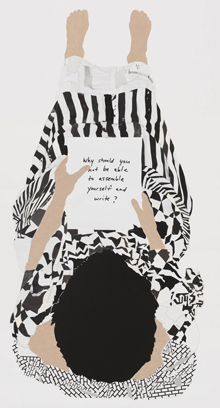


torsdag 21. april 2011
Lady Gaga - Gagavision no. 43
..."The creative process is like 15 minutes of vomiting. It all happens in approximately 15 minutes. Then I spend days, weeks, months, years fine-tuning. But the idea is that you have to honour your vomit. You have to honour those fifteen minutes of thoughts and feelings..."

tirsdag 19. april 2011
mandag 18. april 2011

Fear
of drowning,
fear of being that alone,
kept me busy making a deal
as if I could buy
my way out of it
and it worked for two years
and all of July.
(…)
Breathe!
And you'll know . . .
an ant in a pot of chocolate,
it boils
and surrounds you.
There is no news in fear
but in the end it's fear
that drowns you.
-----------
I AM THAT GIRL
Thinking that I would find you
Full of stories
I hadn't told you
A born stalker
I wanted to give you each word
I ran through the streets
Wild for love
I ran through the streets
Knowing I would never find you
-----
THE BLACK ART
A woman who writes feels too much,
A writer is essentially a spy.
(...)
I am that girl
HOUSEWIFE , A . Sexton
Some women marry houses.
It's another kind of skin; it has a heart,
a mouth, a liver and bowel movements.
The walls are permanent and pink.
See how she sits on her knees all day,
faithfully washing herself down.
Men enter by force, drawn back like Jonah
into their fleshy mothers.
A woman is her mother.
That's the main thing.
søndag 17. april 2011
Anne Sexton (1928 - 1974)
Much of Anne Sexton's poetry is autobiographical and concentrates on her deeply personal feelings, especially anguish. In particular, many of her poems record her battles with mental illness. She spent many years in psychoanalysis, including several long stays in mental hospitals. As she told Beatrice Berg, her writing began, in fact, as therapy: "My analyst told me to write between our sessions about what I was feeling and thinking and dreaming." Her analyst, impressed by her work, encouraged her to keep writing, and then, she told Berg, she saw (on television) "I. A. Richards [a poet and literary critic] describing the form of a sonnet and I thought maybe I could do that. Oh, I was turned on. I wrote two or three a day for about a year." Eventually, Sexton's poems about her psychiatric struggles were gathered in To Bedlam and Part Way Back which recounts, as James Dickey wrote, the experiences "of madness and near-madness, of the pathetic, well-meaning, necessarily tentative and perilous attempts at cure, and of the patient's slow coming back into the human associations and responsibilities which the old, previous self still demands." This kind of poetry, which unveils the poet's innermost feelings, is usually termed confessional poetry, and it is the subject of much critical controversy. A Times Literary Supplement reviewer, for example, said of Live or Die that "many of Mrs. Sexton's new poems are arresting, but such naked psyche-baring makes demands which cannot always be met. Confession may be good for the soul, but absolution is not the poet's job, nor the reader's either." A Punch critic added, "When her artistic control falters the recital of grief and misery becomes embarrassing, the repetitive material starts to grow tedious, the poetic gives way to the clinical and the confessional." Many reviewers raised at least two questions. First, should her poetry be classified as confessional? Second, does her work consistently demonstrate the artistic control which many critics feel is an essential quality of good poetry?
Concerning the first question, Erica Jong objects to the classification: "Whenever Anne Sexton's poems are mentioned, the term 'confessional poetry' is not far behind. It has always seemed a silly and unilluminating term to me; one of those pigeonholing categories critics invent so as not to talk about poetry as poetry.... The mind of the creator is all-important, and the term 'confessional' seems to undercut this, implying that anyone who spilled her guts would be a poet." Sexton also often denigrated the term, but at times she applied it to herself. She told Berg that "for years I railed against being put in this category. Then ... I decided I was the only confessional poet." Moreover, in an interview with Patricia Marx, Sexton discussed the effect on her work of another poet often called confessional, W. D. Snodgrass, and acknowledged the confessional quality of her writing: "If anything influenced me it was W. D. Snodgrass' Heart's Needle.... It so changed me, and undoubtedly it must have influenced my poetry. At the same time everyone said, 'You can't write this way. It's too personal; it's confessional; you can't write this, Anne,' and everyone was discouraging me. But then I saw Snodgrass doing what I was doing, and it kind of gave me permission."
The second question is perhaps best answered in critics' specific responses to several of her individual books. Like many of Sexton's volumes, To Bedlam and Part Way Back received a mixed response. Dickey praised the subject of the work, but found that "the poems fail to do their subject the kind of justice which I should like to see done.... As they are they lack concentration, and above all the profound, individual linguistic suggestibility and accuracy that poems must have to be good." On the other hand, Melvin Maddocks believed that "Mrs. Sexton's remarkable first book of poems has the personal urgency of a first novel. It is full of the exact flavors of places and peoples remembered, familiar patterns of life recalled and painstakingly puzzled over.... A reader finally judges Mrs. Sexton's success by the extraordinary sense of first-hand experience he too has been enabled to feel." Barbara Howes thinks that many of the poems are flawed, but overall she judged Bedlam "an honest and impressive achievement."
All My Pretty Ones also garnered mixed reviews. Peter Davison found one poem, "The Operation," "absolutely superb," but he felt that none of the others are nearly as good. Dickey's critique was even stronger: "Miss Sexton's work seems to me very little more than a kind of terribly serious and determinedly outspoken soap-opera." Yet in an essay on both Bedlam and Pretty Ones, Beverly Fields argued that Sexton's poetry is mostly misread. She contended that the poems are not as autobiographical as they seem, that they are poems, not memoirs, and she went on to analyze many of them in depth in order to show the recurrent symbolic themes and poetic techniques that she felt make Sexton's work impressive.
Dissent among the reviewers continued with the appearance of Live or Die, Sexton's best known book. A Virginia Quarterly Review critic believed that Sexton was "a very talented poet" who was perhaps too honest: "Confession, while good for the soul, may become tiresome for the reader if not accompanied by the suggestion that something is being held back.... In [ Live or Die ] Miss Sexton's toughness approaches affectation. Like a drunk at a party who corners us with the story of his life,... the performance is less interesting the third time, despite the poet's high level of technical competence." Joel O. Conarroe, however, had a more positive view of Sexton's candor. "Miss Sexton is an interior voyager," commented Conarroe, "describing in sharp images the difficult discovered landmarks of her own inner landscape.... Poem after poem focuses on the nightmare obsessions of the damned: suicide, crucifixion, the death of others ..., fear, the humiliations of childhood, the boy-child she never had.... It is, though, through facing up to the reality (and implications) of these things that the poet, with her tough honesty, is able to gain a series of victories over them.... All in all, this is a fierce, terrible, beautiful book, well deserving its Pulitzer award."
Transformations, a retelling of Grimm's fairy tales, marked a shift away from the confessional manner of her earlier work, which several commentators found to be a fruitful change. Gail Pool, for example, contended that the tales provided Sexton with "a rich medium for her colorful imagery," a distance from her characters which allowed wit, an eerie realm "where she had always been her sharpest," and "the structure she needed and so often had difficulty imposing on her own work. At last she had found material to which she could bring her intelligence, her wit, all that she knew, and she created, in Stanley Kunitz's words, 'a wild, blood-curdling, astonishing book.'" Christopher Lehmann-Haupt echoed Pool's analysis, arguing that Sexton's earlier work tended to lack control, that perhaps she worked too closely with firsthand experience. Lehmann-Haupt continued, "by using the artificial as the raw material of Transformations and working her way backwards to the immediacy of her personal vision, she draws her readers in more willingly, and thereby makes them more vulnerable to her sudden plunges into personal nightmare." Similarly, Louis Coxe discovers a new objectivity and distance in Transformations, which he considers "a growth of the poet's mind and strength."
In The Death Notebooks, The Awful Rowing toward God, and 45 Mercy Street, the last two published posthumously, Sexton returned to the confessional method. While these books have been praised, they have also been more severely criticized than her early writings, many readers detecting a deterioration in quality. William Heyen remarked that Sexton's "poems went almost 'steadily downhill, became less intense, less dramatic, less interesting as one book followed another.... There were moments, occasional lines or even poems that wept or raged with her old power," but overall her voice became often "maudlin or patently melodramatic or simply silly." Heyen added that Awful Rowing continues the downward trend; it is touching, "but it's not very good." Robert Mazzocco seconded Heyen, commenting that while the early poems "depict intensely introverted states in highly extroverted style" and are well constructed, the later poems "seem to me less commanding, strike dissonant strains, chromatize the keyboard, or become programmatic." In like manner, Patricia Meyer Spacks argued that Sexton's poems become more and more sentimental in that they overindulge in emotion and fail to evaluate that emotion. The sentimentalism becomes "painfully marked" in Awful Rowing, "with its embarrassments of religious pretension.... The problem of internal division, the perception of divinity, the will to rebuild the soul: all alike register unconvincingly. The poetry through which these vast themes are rendered is simply not good enough."
On the other hand, not all critics disparaged the later books. In a response to Spacks's critique, Jong commented: "Let's be fair about Sexton's poetry. She was uneven and excessive, but that was because she dared to be a fool and dared to explore the dark side of the unconscious." Moreover, Sandra M. Gilbert believed that The Death Notebooks "goes far beyond [the earlier volumes] in making luminous art out of the night thoughts that have haunted this poet for so long." Finally, Jong, in a review of Notebooks, assessed Sexton's poetic significance and contended that her artistry is often overlooked: "She is an important poet not only because of her courage in dealing with previously forbidden subjects, but because she can make the language sing. Of what does [her] artistry consist? Not just of her skill in writing traditional poems.... But by artistry, I mean something more subtle than the ability to write formal poems. I mean the artist's sense of where her inspiration lies.... There are many poets of great talent who never take that talent anywhere.... They write poems which any number of people might have

lørdag 16. april 2011


tirsdag 12. april 2011
mandag 11. april 2011

Abonner på:
Innlegg (Atom)